

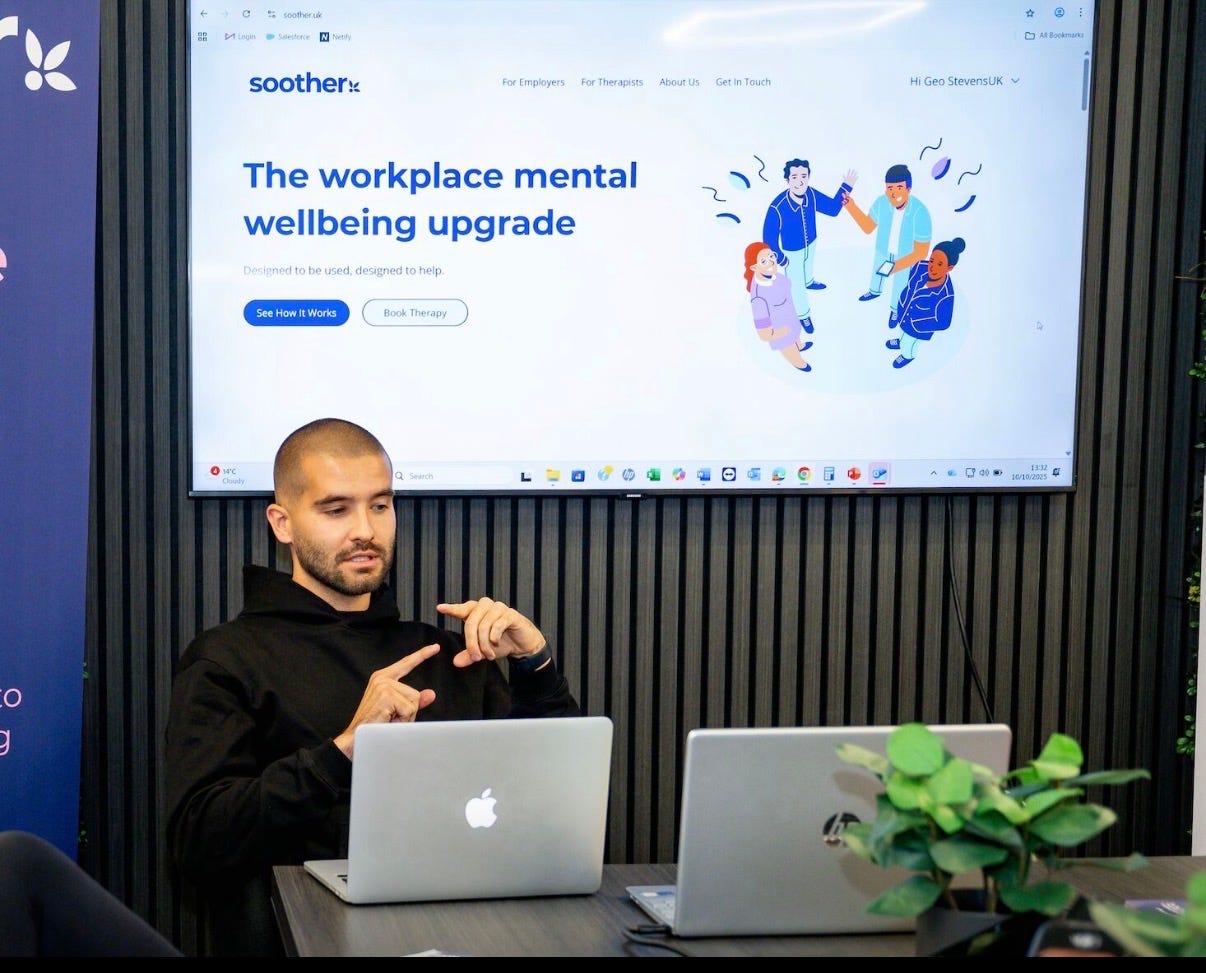
Ahead of the World Cup starting I spoke to England superfan and founder of Soother, George Stevens. We talked all things England, the enormous pressure players face at the elite level and his belief in the importance of therapy.
You’re a huge England fan—where does that passion come from?
You know, I’m not entirely sure. A mixture of two main things I think.
Firstly, I’m a West Brom fan in an area (and friendship group) dominated by Blues and Villa idiots so maybe having games to go to, and watch with a big group of friends, all supporting the same team probably comes into it.
Secondly, I also just love what it does to the country. In the recent tournaments I’d turn up to work in an industry that rarely shows an interest in football and everyone on set was talking about the England football team, where they watched the last game and where they plan to watch the next. Brilliant.
The positive feeling towards our country that sets in during tournaments too (when we’re winning), because it’s an incredible place but us English can be quick to play it down, or yearn to be somewhere else, but I love this country. The countryside, the changeable weather so the sun shining feels like actual heaven opened up (for half an hour), the food, the mix of people, the tradition (the good ones), I just love it.
So a mixture of those I’d say, partly supporting the same team as everyone else and partly just love this country and being lucky enough to grow up and live in England.
How do you think England are shaping up going into the World Cup?
I’m not sure. The last 3 tournaments I’ve been convinced we’re winning it all. I can make a case for us to win this one but the confidence isn’t quite where it was the last 3 tournaments. But hey, we didn’t win then so maybe I’ll get it wrong again and we’ll win it. (We probably will).
What do you see as the biggest strengths in the squad right now?
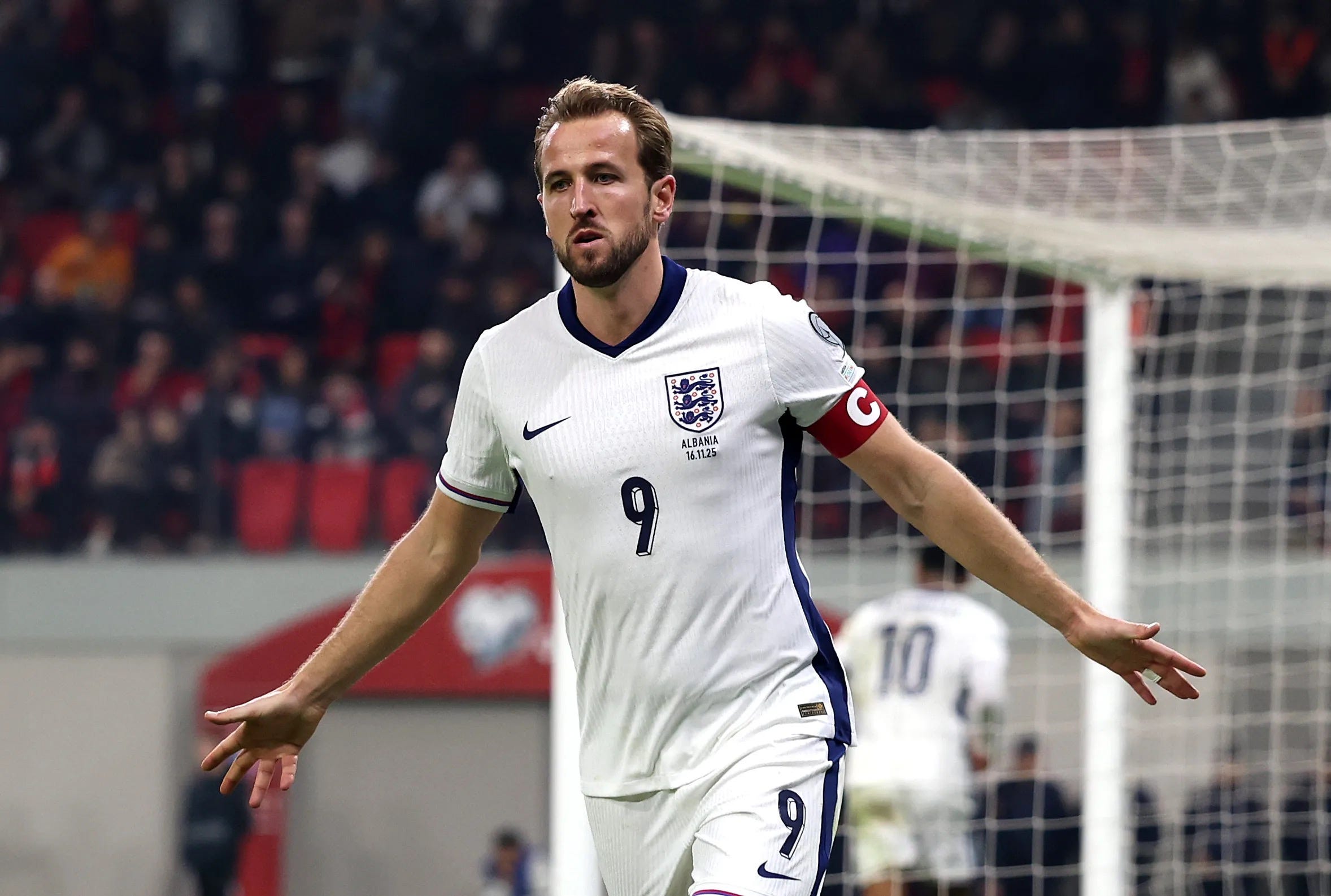
Harry Kane.
When you play even an average side with a genuinely world class number 9 it’s nerve wracking and dangerous, and we’re much more than an average side. He’s the best number 9 in the world by quite a distance and with a 9 like that, you always have a chance, in any game.
And where are the vulnerabilities?
I’d say depth probably. We are absolutely not injury proof. There are an alarming number of players that we just couldn’t replace if they get injured and that makes us a bit vulnerable. Without any of Harry Kane, Declan Rice, Marc Guehi, Jordan Pickford, Reece James we are much worse off. Our starting XI and in some areas our options are really, really good. But one or two unfortunate injuries and it’ll be very, very tough.
Do you trust the manager to get it right tactically in a tournament setting?
Tactically, yes I do. He’s been there and done it in the biggest cup competitions, which bodes well. I think international football is a little bit different in terms of access you get to the players and the time you get to implement the more complex tactical bits, so it’s a lot to do with the bits around the football that are so important.
Unfortunately it’s the bits around the football I’m not 100% sold on yet. He seems to have fallen out with people almost everywhere he’s been. So it’s a feeling of hope that he gets those bits right, rather than confidence. But hopefully the wider FA team that have been involved for a long time will still carry on a lot of what worked so well for us under Southgate.
Who’s your “player to watch” that might not be getting enough attention?
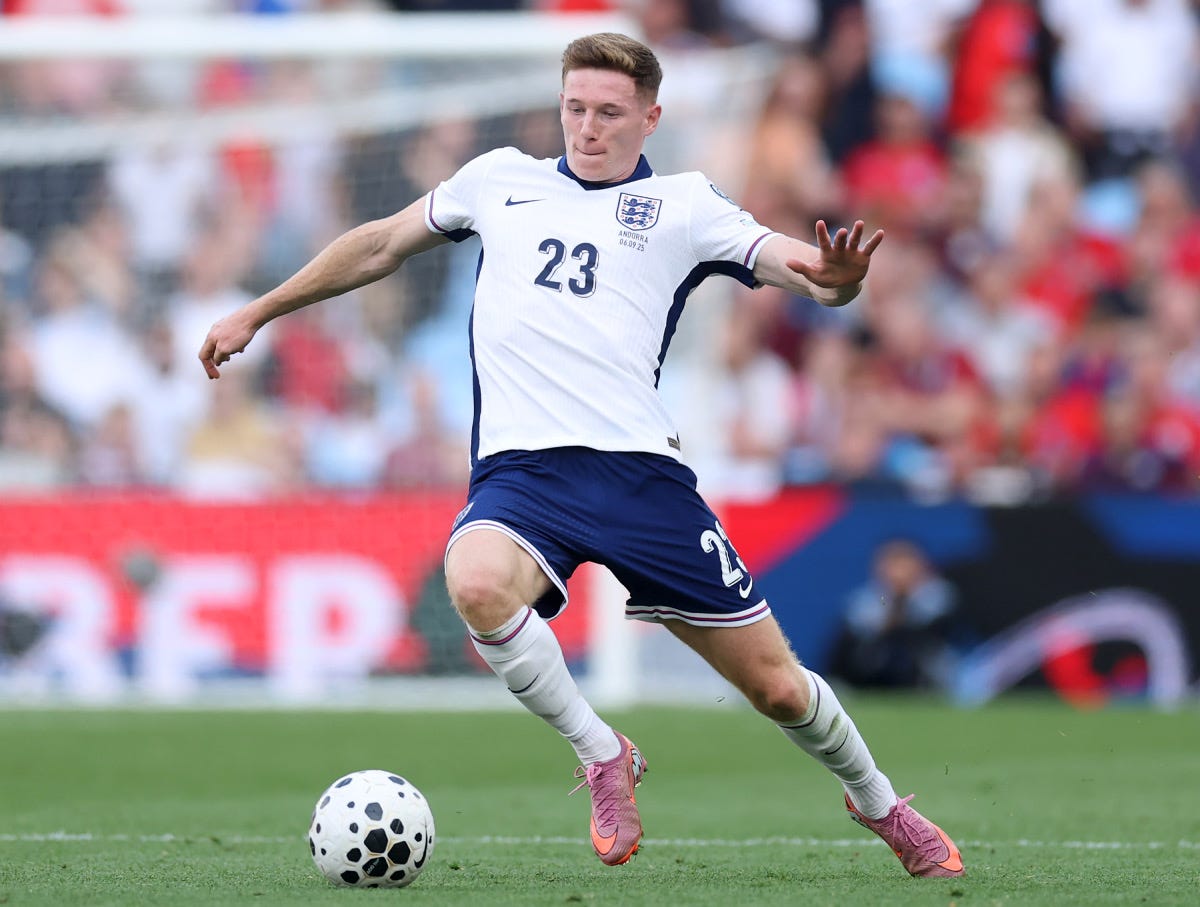
Good question, there’s a couple. First would be Elliot Anderson. I think everyone acknowledges how good he is, but that player next to Rice has been so important previously and if he can be as good as, or better than Kalvin Phillips was for us in Euro 2021, he’ll be really important.
Secondly, a bit more rogue might be Madueke to share the right hand side with Saka. I wasn’t sold on him for a while and to be honest I’m still not sure, but in terms of someone that could fly into a 4-5 game spell of top form, he has that about him. He’s sharp and gets past people and later on it games that could be handy.
Equally he could go and not kick a ball and I’ll pretend I never said this. But he’s sharp, he could do something and I hope he does.
Realistically—how far do you think England will go?
Underestimate Southgate at your peril. He did a phenomenal job and I don’t buy that we’re automatically better off with him not in the job, as some people seem desperate to scream and shout. So there is part of me that worries we could be back to pre-Southgate disaster central.
That said, we’re really, really good. We have top players and a top club manager. If he’s able to adapt to the tournament thing, then we have a really good chance.
I think we’ll be in the mix. Manage the heat and fall the right side of the really fine margins in the knockout games we genuinely could do it.
Na go on, I think we’ll win it.
⸻
Footballers are under intense pressure—do you think the conversation around player mental health has genuinely improved?
I think the conversation around mental health on the whole has improved and is improving, with a long, long way still to go. I think in football specifically, I haven’t seen much evidence of behaviour change around football in terms of abuse, in person and online. It’s still all a little bit heavy in my opinion.
I sense a feeling among fans / non-footballers that because they earn so much money, they can’t possibly struggle with their mental health and it just doesn’t work like that.
I don’t work in football so I say this acknowledging that I’m not an expert, but sometimes mental health support that’s separate from performance can help. My assessment as an outsider, from the conversations I’ve had with people working in football, is that mental health support is there for footballers in a crisis but other than that, anything psychological tends to be with an eye on performance optimisation, with therapy for the human being, not the footballer, being less of a priority.
At Soother we work with mental health proactively and, using football terminology, on the front foot. You don’t need to be in a crisis to benefit from therapy. In actual fact, if you get support before you’re in a crisis, you may never reach crisis point.
And it’s the human being that needs mental health support, not the job role.
What more could be done at the top level to support players psychologically?
I think the conversation is shifting but there’s a lot more to be done in terms of judgement and stigma, around acceptance that mental health support is normal and accepted and it’s a healthy thing to engage with, rather than a marker of anything negative.
I think then the access to quality support can be improved in all areas. The fewer people someone needs to ask to find appropriate support, the better. Services like Soother that open access in a very clear, easy to use and discrete way help.
And as mentioned above, mental health support for the human being, not the footballer. An accountant doesn’t go to a therapist as an accountant, they go as the human being. The same applies to footballers. Live and worth being dependent upon performance can cause real difficulty. If the mental health support centres around performance, that can just exacerbate what’s going on, rather than help.
Do you think fans are becoming more aware, or is there still a gap?
I think there’s still a gap. On a similar note to above, I think often fans struggle to see the human being rather than the footballer.
And we’re all human and none of us are immune to struggle, however fortunate we may be in one area or another of our lives.
What inspired you to start Soother, and what problem were you trying to solve? What are you doing differently?
Two main areas are access to the service and the quality of the service.
Soother couldn’t be easier to use. Organisations sign up, we introduce ourselves to employees and let them know exactly what they have access to and how to access it, then they book sessions as easily as they’d book a haircut or a restaurant. There are lots of brilliant therapists out there with space in their diaries and there are lots of people waiting for mental health support. We are improving the bit in the middle so more people can access therapy than before.
But access is no good if the quality of service isn’t high quality. There’s a quiet problem of therapists being paid poorly for their work and if therapists are underpaid and overworked, everyone loses. So we pay our therapists well, we support them in their work and we vet them thoroughly, with very high standard of criteria to hit, so we can guarantee as far as possible that our service is high quality.
In your training as a therapist, what’s been the most eye-opening thing you’ve learned
about people?
Probably just how much therapy can help. Life can be really difficult and some people can be having a really difficult time. And then you engage with a human being, that cares, that holds some space for you safely and listens without judgement and something really transformative can happen. And I already loved human beings but having experienced that and seen it multiple times, I love humans even more. I wish we could see how great we are a little bit more because we’re all we’ve got, but that’s enough!
What are the biggest misconceptions people still have about therapy?
I think there are a few but I’d say a very key one is the belief that you need to be really struggling to access therapy. That just isn’t the case. Yes it’s there for people in the very difficult times, but you don’t need to be in a crisis to benefit from therapy and as I mentioned before, if you can access support easily, before crisis point, you may never reach crisis point, and I think that’s better for everyone.
I’d also say that therapy itself is a little bit misunderstood. I had whole psychology degree and still had no idea what therapy actually was and what it wasn’t. It isn’t about talking to someone and telling them what’s wrong and them telling you what to do and ‘fixing you’, which I think is quite a common misconception. It’s a relationship with another human being that takes whatever shape you need it to, led by you, to get what you would like from it. We are each the expert of our own lives, it just helps to have a therapist to sit with us and see us and create a safe space together to explore stuff!
What did your time as a model teach you about confidence and self-image?
Modelling is completely different to football, but there is similarity in the sense that people sometimes see the job title before the human. There can be an expectation around confidence and self-assuredness and in reality, to link worth and image so closely, to the extent that your earnings depend on the way you look, can be quite troublesome and understanding that your value as a human being doesn’t come from your appearance can get a bit blurry and confusing. Particularly because models often start so young when they’re still developing a sense of self and values.
A big thing is that I’ve never met anyone without insecurities. The people you compare yourself to, also compare themselves to others. And probably the biggest things on confidence for me are that it can develop massively over time, it isn’t fixed, in either direction, and also being confident, appearing confident and feeling confident are all very different things. In some of my work I look back now at images or commercials where I look as confident as can be when on the inside I was terrified. Does getting it done anyway make it confidence? Does looking confident make it confidence? I’m honestly not sure, but it lines up with the earlier point that appearances can be deceptive. What looks like total confidence might absolutely not be under the surface and no one is immune from insecurities. They’re very human.
Did being in that world impact your mental health, either positively or negatively?
Yes and no. I think there are elements of the work that impact things like the above, linking appearance with importance and success and worth is a risky game.
Self employment comes with its challenges but also itss benefits. It isn’t a particularly stressful life in lots of ways, but in other ways it is. And there’s a little bit of invalidation if a model talks about the difficulty of the work because it’s ‘just having pictures taken’. But believe it or not, some of the days are tough! I’ve done lots of jobs over the years, from an office to groundwork to a restaurant kitchen, the toughest modelling days are the toughest work I’ve done.
But aside from the modelling I’m pretty sure I’d have been quite a lot like I am now regardless of my career, so it’s hard to know how much of me now is a direct consequence of modelling or not.
How has your perspective on identity and self-worth changed since then?
Training to be a therapist has been pretty eye opening and transformative in itself. As part of the qualification you have to have a lot of personal therapy and that’s really helped too. A lot of the work around self worth and what it does and doesn’t depend on has changed some internal beliefs. Therapy has really helped set all that stuff out, look at it and get a good grip on how I do and don’t feel about things and which beliefs are actually mine and which have come from outside of myself and can therefore be moved on.
Probably the biggest change I’ve made is the way I speak to myself. I’m unbelievably positive and caring in my self talk now, when I used to be extremely critical, very quickly. I think that’s quite closely linked to self worth. I acknowledge my worth now, even in the moments I’m making mistakes or not quite feeling tip top, which I think reflects a change in my self-worth.
Honestly the biggest thing for me has been therapy. So much so that I started Soother to get as many people into therapy as possible.